
Inside Folio Photonics — How Heartland Materials Science and Venture Capital Are Solving the AI Era’s Data Problem
An NVCA Startup Stories feature
Ask Steven Santamaria why he traded a long career at one of the biggest names in technology for a startup, and he lights up. As CEO of Folio Photonics since 2018, he is betting that the next breakthrough in data storage will not come from the incumbents who have run the industry for decades, but from a small company willing to rethink the problem from the ground up. So far, the bet is looking sound.
That bet is colliding with one of the most consequential infrastructure questions of the AI era. Every model trains on enormous volumes of data and generates even more, all of which has to be stored, secured, and kept for years. The archival layer underneath the AI boom is running on technology patented decades ago. Folio Photonics is building something new for it, and venture capital is what made the attempt possible.
A 1950s problem meets an AI-sized demand
Data storage is foundational infrastructure; the kind most people never think about until it runs out. The industry rests on three products: semiconductors and SSDs, hard disk drives, and tape. The trouble, as Santamaria tells it, is the pace of progress. “Some of those technologies were patented in 1950,” he said, “and the pace of innovation has slowed. They got themselves into a commodity situation, where the cheapest one wins.”
Then AI arrived and changed the scale of the problem. “What AI does is create an incredible explosion of the need for more data and more interesting ways to store it,” he said. Models train on massive datasets and generate responses that must themselves be stored, for compliance and to train the next model. “A few years ago, a token was something you put in a slot at an amusement park,” Santamaria said. “Now everyone talks tokens. And they all need to be stored.” Folio Photonics is positioning to serve that demand with a denser, cheaper, more secure, and more energy-efficient archival option.
The energy math makes the case even sharper. Hard disk drives draw power around the clock. “Hard disk drives never stop spinning,” said Paul Deninger, Operating Partner at NVCA member firm Material Impact and a Folio Photonics board member. That spinning consumes electricity and generates heat, which data centers must then spend more electricity to cool. Optical storage sidesteps both, because the disc sits at rest until the data is needed. At a moment when data center energy demand has become a live policy question, Deninger argues the technology could meaningfully reduce the storage industry’s draw on the grid. “I can’t think of another technology that can do that,” he said.
An idea that came from looking sideways
Folio Photonics traces back to a Case Western Reserve University physicist who, working through the NSF-funded Center for Layered Polymeric Systems, developed a multilayer optical storage disc built on polymer science rather than magnetics. It is a textbook example of the pipeline that turns publicly funded research into a company: a university lab, a federal research grant, and eventually the private capital to commercialize what they produced. That connection did not end at the founding. The company still works with nearby research institutions and runs internship programs that pull engineering talent from the lab bench toward a commercial product.
What makes the founding insight worth studying is where it came from. “You take something orthogonal,” Santamaria said, “and you solve a problem that people do not look at, because they are stuck in, this is how we have always done it.” A hard disk drive is always made a certain way. “Who would think of making a film that turns into a plastic disc?” The breakthrough came from applying expertise built up in one field, advanced polymer and film manufacturing, to a problem no one in storage was looking at.
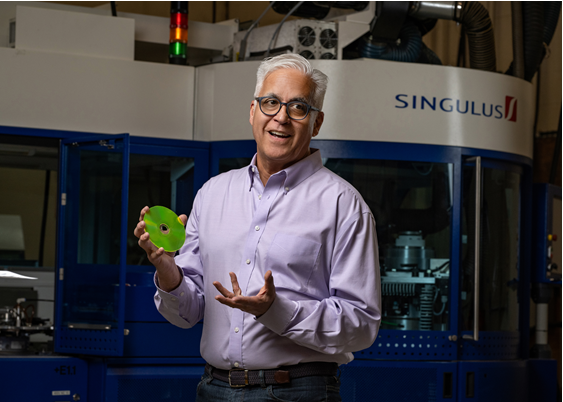
That kind of cross-disciplinary collision is exactly what venture capital exists to fund. It rarely fits a tidy thesis, and it rarely comes from the obvious place. Folio Photonics pairs materials scientists with veteran data-storage engineers at a second site in Colorado, near where much of the hard-drive industry built its talent base. “You meld those two worlds together,” Santamaria said, “and magic happens.” Deninger sees the same pattern from the investor side. “There are pockets of technology all over this country,” he said, pointing to Colorado’s fifty-year lineage in storage technology and the Midwest’s deep base of polymer manufacturing talent that staffs the company’s Cleveland operation. It is also a reminder that breakthrough technology does not require a coastal zip code. The talent, the manufacturing base, and the university research were already in place. What had been missing was capital willing to take the shot.
What venture capital unlocked
Folio Photonics closed an $8 million Series A in 2026, co-led by Material Impact and The O.H.I.O. Fund, with a roster of backers that includes NVCA members JobsOhio Ventures and Pavey Investments. But when Santamaria describes what venture capital has meant to the company, funding is only the starting point.
“It validates you,” he said. “When we got Material Impact, people went, oh, those are legit VC firms. Okay, now we are validated.” The support has been just as concrete. After a three-year search for an optical engineer, a discipline so specialized Santamaria jokes there are only a couple hundred on the planet, the connection finally came through an investor, Ray Leach of The O.H.I.O. Fund and founding board member of Venture Forward, who shared a winning resume. The same network has helped with marketing, recruiting, and the unglamorous work of building a company. “The things you do not want to spend your raise on, they have been helping quite a bit,” he said.
For Material Impact, the relationship began well before the Series A. The firm is a deep tech venture fund focused on early-stage materials science, built on the conviction that foundational materials are what move the entire innovation economy forward. Material Impact made the initial seed investments that carried Folio to the point where it could raise an institutional round, then co-led the Series A.
That history reflects a side of venture capital that rarely makes headlines. “We have been patient capital for this company,” Deninger said. “These deep science technologies require a longer term commitment of capital than is typically the case.” When Folio needed continued backing to push development toward market, Material Impact invested again through its follow-on strategic opportunities fund.
The partnership is also hands-on, drawing on Deninger’s forty-five years in the technology industry as a banker, CEO, and board member of companies large and small. “I do a lot of executive coaching,” he said. “I’m a former CEO myself, so I understand how complex and lonely the job is.” He is actively helping the company shape its business development partnerships, and his network has opened doors that would otherwise take years to reach.
Kristi Tanner, who works with Folio Photonics through The O.H.I.O. Fund, describes the relationship in terms that go well beyond the wire transfer. “It is really about supporting Steve in everything he is doing,” she said. That is the dynamic NVCA works to protect, and it is not specific to any one state. Venture capital turns university research into products, draws specialized talent to companies that could not otherwise compete for it, and gives founders a reason to keep building in communities across the country rather than only in a handful of established hubs.
Skating to where the puck is going
Asked what he would tell the next generation of founders, Santamaria reaches for a hockey metaphor. “You skate to where the puck is going,” he said. “Do not look in the rearview mirror. Look forward and find these opportunities, because they are abundant.” His encouragement is built on experience. “I was scared to death the first time I started a company,” he said. “But things tend to work themselves out. Part of my job as CEO is to be the biggest cheerleader in the building.”
Folio Photonics is, in the most concrete sense, an American innovation story: a novel idea, drawn from an unexpected place, aimed at a problem the rest of the market had quietly accepted. Deninger believes Folio is a preview rather than an exception. The next generation of innovation in sustainability, energy, and industrial redesign, he argues, will come largely from the middle of the country, and it has to be funded. It is also a venture capital story, a clear example of what early-stage capital and aligned partners can unlock that bootstrapping alone could not. None of it is possible without a healthy venture ecosystem and the policy environment that allows it to function. When capital is willing to back a new idea, breakthroughs can come from anywhere, and from anyone willing to take the shot. That is the kind of ecosystem worth protecting.
Folio Photonics is backed by NVCA member firms Material Impact, JobsOhio Ventures, and Pavey Investments, along with The O.H.I.O. Fund and other investors. This story is part of NVCA’s Startup Stories, an ongoing series on how venture-backed founders drive American jobs, innovation, and economic growth, and why the policy environment around venture capital matters.